Accountability to those in our wake
Hi friends,
Fall has finally descended, in our corner of the world. We hope, wherever you are, you’re finding warmth and light as the seasons may change around you.
A note from Mia
The four conditions of Interconnected Freedom–Mutuality, Embodiment, Pragmatic Faith, and Transformation–are so present in the world. It’s different from frequency illusion: the cognitive bias that make something new to you seem more common than it is. It’s more like gaining the ability to see a more nuanced spectrum of colors and then realizing how much more vibrant everything is.
Pragmatic Faith has been showing up to teach me lessons recently. Faith, more broadly, is believing or acting regardless of the evidence we have. Pragmatic Faith is believing that another, better world is possible and on its way, while acknowledging the realities we face in our current world. Pragmatic Faith asks us to trust that we can receive the care we need in our lives, prompts us to provide that same care to others, and prevents us from accepting uncaring conditions as inevitable or natural. It’s a kind of a “be the change you want to see in the world” thing.
We are moving through the river of life in the wakes of those that came before us and those that live alongside us. And that wake has an impact on the world we live in now, as well as the world to come.

I was in New Haven a few weeks ago to facilitate the workshop Next River has been prototyping with a community of folks brought together by CEIO. One of the participants asked about the trust necessary to practice Pragmatic Faith, and how to do it when it’s hard, how to do it when previous experience makes trusting the world hard. It’s relatively easy to take actions that sprinkle love into the wake when we’re feeling the love, or we are well-resourced. We can engage in our acts of kindness or hope or care when we are cared for and feeling hopeful. This is part of Pragmatic Faith. But another part comes up when we are feeling depleted or wronged.
I was in the airport on my way to New Haven when I got the news. My friend and colleague Olufunmilola “Lola” Adedokun died on October 16th, the day before. Her death was sudden and in an airport. She’d just turned 43. I’ve worked with Lola for the last three years, since she took over leadership of the Aspen Global Innovators Group, where I co-facilitate the Healthy Communities fellowship. I remember first meeting Lola and immediately being thrilled to know her. Her vision, clarity, and passion. After my New Haven trip, I was supposed to fly to DC to see her and her team. How could she be gone? It was a punch in the chest. My mind was spinning and I felt unmoored.
I called my husband and cried in the hallway on the phone with him. I kept seeing her face—her smile, her head tilt, her laugh. I could hear her voice.
My flight to New Haven was delayed. I got a donut. A mutual friend called and I cried at the gate with her.
When I finally boarded the plane, there was a flight attendant who was . . . extremely unhelpful. I was tired, I was in emotional shock, and my patience was thin. In my head, I began to formulate the ways in which I was going to go off on her. She was going to have to come back up the aisle and talk to me at some point, so I was getting ready for a fight.
I was hot, y’all. I felt myself edging toward something that caught my attention. My core was clenched, my chest was contracted, my thoughts/feelings were spinning. It was only the intensity that made me notice myself. The noticing created a small disruption in the spinning, enough for me to turn toward a little compassion—the flight had been late, maybe she was tired, maybe she’d been dealing with assholes all day. This benefit of the doubt made a little space for me to pay attention to myself. I took some slow breaths.
Then I thought about Pragmatic Faith. I thought about what might be in the wake Ms. Unhelpful was swimming in. But mostly, I thought about who might be downstream of her and what my additions to the wake might do to them. The interactions between she and I are not a bound container. If I throw shit into the water, the people downstream have to drink shitty water. It wasn’t my fault that she was behaving badly toward me, but what responsibility would I claim to transform what I was receiving? What did it look like for me to remember that I am not an individual in a vacuum? This moment was inviting me to remember how deeply interconnected we are. If I couldn’t bring myself to kindness for the wellbeing of the person in front of me, I could for the unknown people downstream of her. They were not responsible for her unkindness and shouldn’t be punished for it.
And then I did an exercise based off of something Prentis Hemphill, teaches, something I could do sitting in my airplane seat. I found my center and dropped into it. I let gravity really hold me. I felt my length, my width and my depth. I felt my dignity and connection to all that has been, is, and will be. I tensed my muscles and acknowledge the anger, grief, and exhaustion I was feeling. I relaxed my muscles and allowed those feelings to release, or at least soften. It wasn’t about getting rid of the feelings, but not letting them explode or be suppressed.
To be clear, there are times when we are wronged or harmed when we should not stay quiet or engage in any cheek-turning. There are times for confrontation and fighting back. There are times that standing up for yourself is the right thing to do for you and others down stream of you. This was not one of them.
So, I kept my mouth shut, I drank a lot of water and one gin and tonic and let the anger give way to grief and sadness.
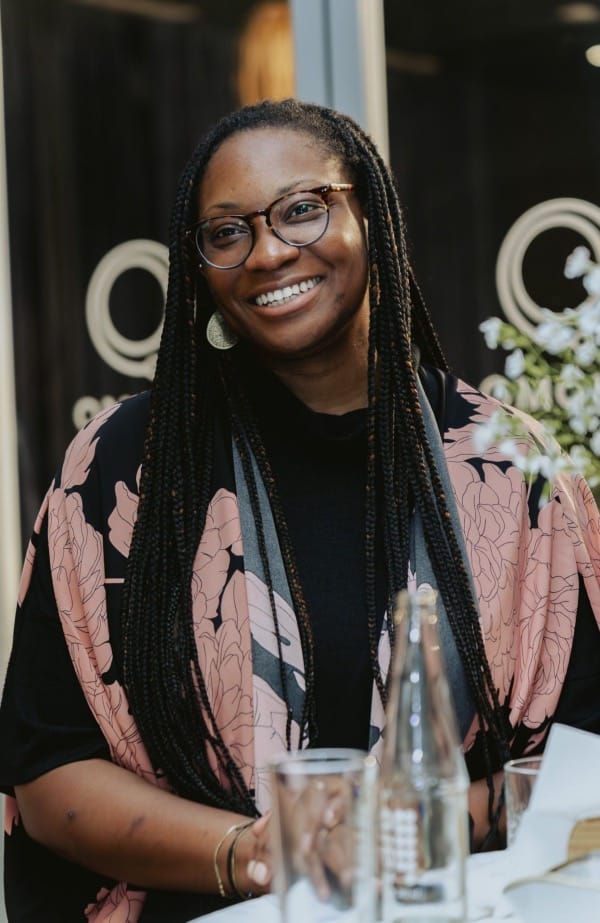
This experience with the flight attendant reminded me of something I learned from Mia Mingus about living an accountable life. Because accountability is a practice that asks us to take action when we are behaving at our worst, but acknowledges that we are never just the worst thing about ourselves. In her words, shared in a blog post from 2019: “Accountability is not a destination, it is a skill we can build and practice. It is an art, a craft, an alchemy we can learn how to wield, just as we have learned how to wield hurt and shame and fear.” Pragmatic Faith shows us how to be accountable to those who follow in our wake. How to embrace that accountability as a profound practice of our humanity.
And, to close with Mia Mingus’ wisdom and words as a guide (pulled from the same blog post quoted above):
- “What if accountability wasn’t scary? It will never be easy or comfortable, but what if it wasn’t scary?
- What if our own accountability wasn’t something we ran from, but something we ran towards and desired, appreciated, held as sacred?
- What if we cherished opportunities to take accountability as precious opportunities to practice liberation? To practice love?
- To practice the kinds of people, elders-to-be, and souls we want to be?”
Current inspiration
In this bananas, fraught, painful, frustrating election season, I’m going to be yet another person reminding you to pay attention to how you vote down ballot. Part of the reason we are where we are today is because of the right’s strategy of seeding their ideology and power through leadership at the local level. It matters for many reasons.
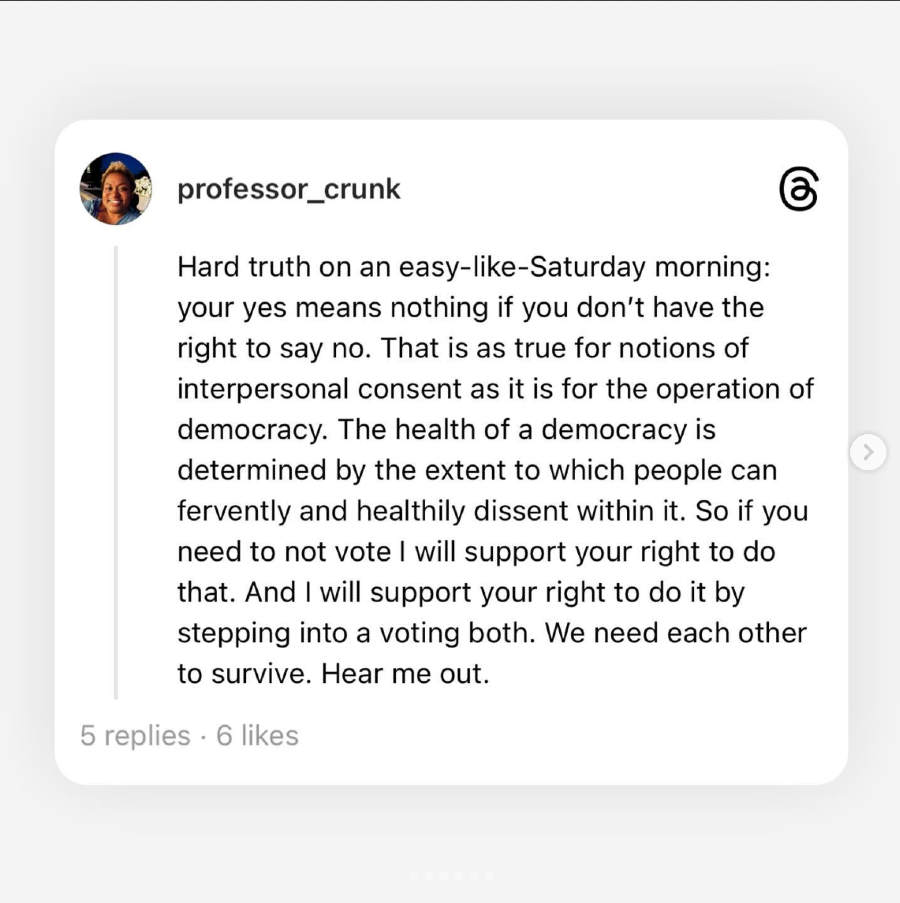
As for the Presidential election, I will share this thoughtful post from Brittney Cooper. (Click through to read the entire thing, as well as her caption).
A few other recommendations
Jeremey Scahill and Ryan Grim’s Substack Drop Site. It’s independent investigative journalism on politics and war. It’s not very hopeful, but it’s got high standards for truth and accountability. Doppelganger. Naomi Klein’s latest is for anyone wanting to make some sense of the way fringe conspiracy theories have become mainstream. She starts with her own “mirror world” experience—the public conflation of her and Naomi Wolf—and expands from there. The latest issue of Deem, “Climate Realities and Responses” explores our climate realities and a thriving future that we can commit to.

Member discussion